World of Warships: Ship Types, Tactics & Team Play
A practical guide to the five ship types in World of Warships, the tactics each one brings to a battle, how divisions and matchmaking actually work, and how many players you should expect on the other side.
What World of Warships is
World of Warships is a free-to-play naval combat game developed and published by Wargaming. You command a single warship in team-versus-team battles against other players, most often twelve against twelve. Every ship belongs to one of five types, and each type has a distinct role, a distinct set of weapons and a distinct way of winning. Matches are played online in real time and usually run somewhere between five and twenty minutes.
Progression runs on experience points and credits. You earn experience by playing well — spotting enemies, dealing damage, capturing points, sinking ships — and you spend credits on upgrades, consumables and the running costs of your ship. Premium ships and a premium account speed progression up. They are never required to play or to win.
The five ship types
The game shipped with four types — destroyers, cruisers, battleships and aircraft carriers — and submarines were added permanently in a later update. Your type determines your hull, your armament, your speed and your job in the battle. Light and heavy cruisers are variants within the cruiser type rather than types of their own.
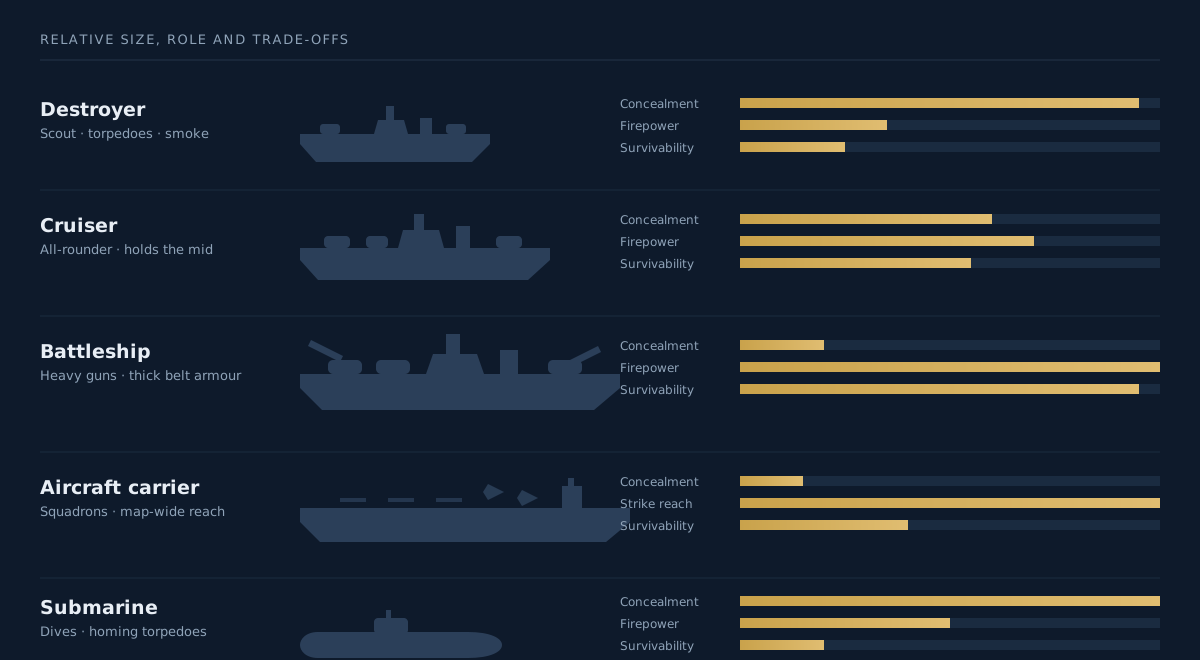
Destroyer
Fast, small and hard to spot. Carries torpedoes, quick-firing guns and, on most lines, a smoke generator. Its job is to spot for the team, contest capture points and put torpedoes into heavier ships from the flank.
Cruiser
Medium speed, moderate armour, fast guns. The flexible middle of most fleets: it screens battleships, hunts destroyers, provides anti-air cover and punishes anything that shows a broadside.
Battleship
Slow, thickly armoured, enormous guns. It trades long-range salvoes, absorbs damage the rest of the team cannot, and can change a battle with one well-aimed broadside — then wait half a minute to reload.
Aircraft carrier
Controls squadrons of attack aircraft, torpedo bombers and dive bombers rather than firing its own guns. It can strike almost anywhere on the map, but it is nearly defenceless if a destroyer reaches it.
Submarine
Dives below the surface, where most guns cannot reach it, and attacks with homing torpedoes. Limited dive time and depth-charge counterplay keep it honest. The newest and most situational type.
Tiers, not types
Ships are also graded by tier, from early-1900s pre-dreadnoughts up to modern late-war designs. Matchmaking works within a narrow tier band, so a tier IV ship never meets a top-tier one.
Tactics by ship type
Each type has a short list of high-leverage habits that separate a player who contributes from one who simply occupies a slot.
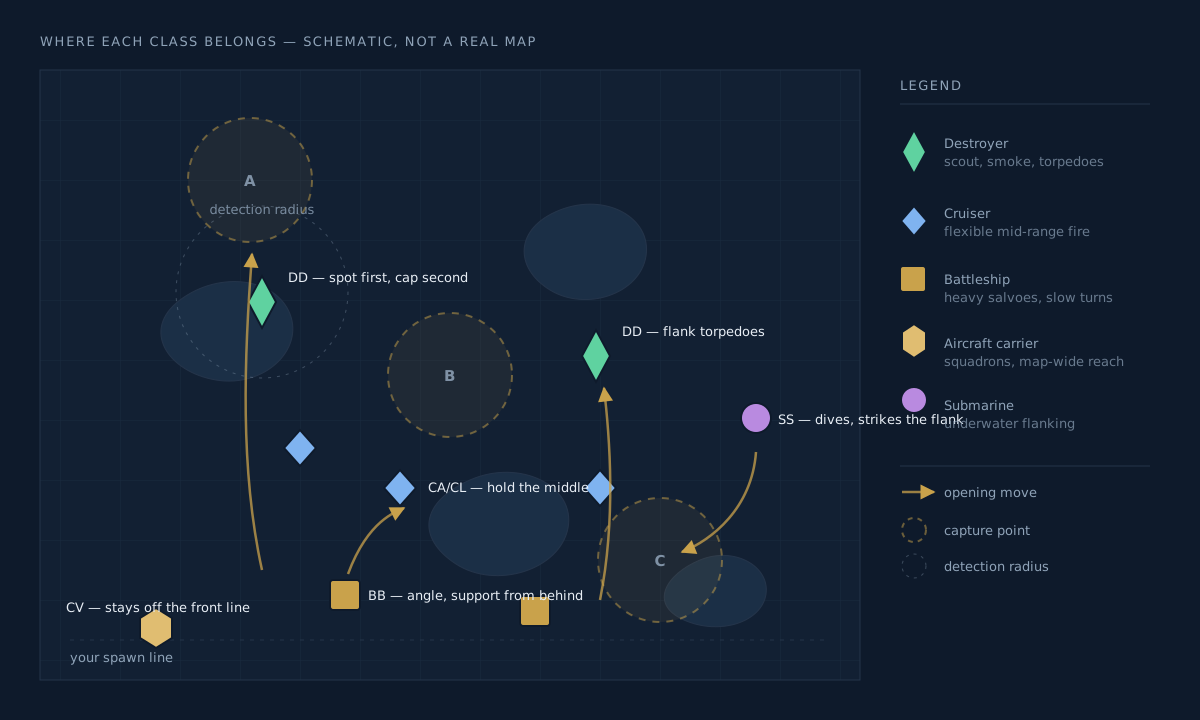
Destroyer. Your spotting is worth more than your damage — a spotted battleship is a battleship your whole team can shoot. Use speed to reposition, not to chase. Launch torpedoes across an enemy’s path, never straight down it. Smoke is for the team as often as for you.
Cruiser. Hold the middle and keep guns on whatever is lit. Turn your anti-air on when squadrons come in. Do not chase a destroyer into open water — that trade almost always favours the destroyer.
Battleship. Angle your hull so shells strike your belt at a slant instead of square on. Never show a flat broadside while reloading. Save the main battery for other capital ships and let your secondaries deal with anything that closes.
Aircraft carrier. Stay well behind your own line, because you cannot fight back at close range. Rotate squadrons so the whole map stays visible. Spotting for your team usually earns more than a marginal strike does.
Submarine. Stay submerged until you have an angle, then surface only to recharge. Attack across the beam, not head-on. Reposition after every volley — a submarine that stays put is a submarine being depth-charged.
Where each type belongs
Most losses at low and middle tiers come down to position rather than aim. The schematic below shows the shape a competent team takes in the opening two minutes of a standard battle.
Ready to take command?
The fastest way to learn any of this is to play a few battles. The game is free to download, and the first tiers are quick to get through.
Advertisement. Sponsored affiliate link.
Divisions, clans and matchmaking
You can queue alone or in a division of up to three players. A division is always placed on the same team, so it is the reliable way to play with friends — but the matchmaker treats the division as one unit, which can lengthen your queue if the ships in it sit far apart in tier.
Matchmaking balances the two teams by tier and by ship type, so a team with three destroyers is normally matched against a team with three destroyers. It does not rank you by skill in random battles; the balance is structural rather than performance-based.
Clans are larger standing groups. Beyond giving you people to division with, a clan runs its own base with economic bonuses and unlocks Clan Battles, a separate seasonal competitive mode played in teams of seven.
Battle types and team sizes
Random Battles are the main mode and are mostly twelve against twelve. Co-op Battles put a smaller team of players against bots and are the gentlest place to learn a new ship. Ranked Battles run in seasonal sprints with tier restrictions. Clan Battles are seven against seven. Operations are co-operative scenarios against scripted waves with their own objectives.
Three basic objective layouts appear across those modes: Standard, where each team has one base to capture or defend; Domination, where several zones on the map award points while you hold them; and Arms Race, where scattered buffs improve your ship for the rest of the match. Map size scales with the mode, so a twelve-a-side random battle is fought on a considerably larger map than a clan battle.
What it costs and who it is for
World of Warships is free to download and free to play. It is funded by optional in-game purchases: premium ships, a premium account that raises credit and experience earnings, cosmetic items and randomised container bundles. You can reach the top tiers without spending, but it takes considerably longer.
Because some of those purchases are randomised, and because the game is played online with strangers, it is worth checking the age rating on the official store listing for your country before you or anyone in your household installs it. Age ratings in Europe are issued by PEGI and are shown on the store page, together with the “in-game purchases” descriptor.
The game runs on Windows PC, with separate console versions. Check the official system requirements before installing — we do not host the download and cannot guarantee it will run on a given machine.
Getting started
Start in a destroyer or a cruiser. Both are forgiving at low tier, both let you contribute from the first battle, and both teach you the map faster than a battleship will. Move to battleships and carriers once you know where ships tend to be.
Play the first few battles in Co-op against bots. You will learn the shell arcs, the reload rhythm and the consumables without costing a team of real players the match, and the mode is available from the start.
Then be patient. Naval combat here is a game of positioning, timing and angles rather than reflexes. The first dozen battles will be rough. Once the habits of your ship type settle in, it opens up.
Advertisement. Sponsored affiliate link — we may earn a commission if you install the game through it. It costs you nothing extra.
About this guide
This guide is written and published by Adamix stavby s.r.o., Semtín 97, 533 53 Pardubice, Czech Republic (Reg. No. 17413109). Editorial contact: info@aerostrata.online, +420 794 596 678. Full details are on our legal notice and about pages.
Last reviewed 16 September 2026. Game details change between updates; if you find something out of date, tell us and we will correct it.
World of Warships is a trademark of Wargaming Group Limited. This page is an independent, informational guide. It is not affiliated with, endorsed by, sponsored by or approved by Wargaming, and no official game assets are reproduced on it — the illustrations above are our own original artwork. The page carries paid affiliate advertising, marked as such wherever it appears.